Listen
The whole sermon (computer voice)24:40 · 5.9 MB
Parts of the sermon (4)
Read the whole sermon 39 KB. Reading uses much less data than listening.
In three minutes (computer voice)1:54 · 455 KB
Pastor Hoon Kim explores Jonah's prayer from the belly of the great fish, revealing how God sovereignly prepares seasons of distress as a womb for the death of the self. Grounded in covenant relationship, true prayer invites believers to cry out to 'my God' with full confidence that the Lord hears and responds to who we are.
Downloads
- Audio (MP3)To listen without internet, or to send5.9 MB
- Three-minute summary (MP3)A short voice message to send455 KB
- Study guide (PDF)Questions for a small group210 KB
- Resources (PDF)Notes to prepare your own sermon595 KB
- Visuals (PDF)Pictures to show while you teach445 KB
- WhatsApp card (picture)A picture to share118 KB
- WhatsApp messages (text)One message for each day of the week2 KB
- The sermon (text)To read or print25 KB

Wilderness and new exodusPrayerSuffering and trialsGod's characterGrace and salvationRepentance and forgivenessJonah
The original sermon in Korean
Hear the sermon as it was first preached, in Korean.
Study guide
Core Truth
God sovereignly prepares times and places of distress, like the belly of the fish, not to destroy us, but as a womb where our old self dies and we discover the royal privilege of crying out to our personal God who responds to who we are.
Key Verse
"From inside the belly of the fish, Jonah prayed to the Lord his God."
Jonah 2:1 (NIV)
Background Notes
- The Literary Frame and "White Space": Jonah 2 is an exquisite Hebrew psalm embedded within a narrative frame (1:17 and 2:10). Just as calligraphy and minimalist poetry rely on "white space" to convey what cannot be stated directly, Jonah's poetic prayer highlights the unspoken reality that God's covenant grace was actively holding Jonah even while he sank into the abyss.
- God Appointed (Manah): In Jonah 1:17, the word translated "provided" or "prepared" is the Hebrew verb manah. God is revealed as the supreme Sovereign who commands nature: appointing the great fish, and later in chapter 4 appointing a plant, a worm, a scorching wind, and the sun to teach His servant.
- From Tomb to Womb: In the original language, the fish is introduced as masculine (dag gadol) in 1:17a, but shifts to feminine (dagah) in 1:17b and 2:1. Ancient commentators and Hebrew scholars note that the word for the fish's belly (me'eh) often denotes internal organs or a mother's womb, transforming the fish from an agent of execution into an incubator of spiritual renewal.
- Three Days as a Threshold: Throughout Scripture, a "three days" period marks a testing ground where the old identity dies so that God's new purpose can begin: Israel's wilderness journey from Egypt to Mount Sinai (Exod 19), Abraham's journey to Mount Moriah (Gen 22), and Jesus' three days in the heart of the earth (Matt 12:40).
Discussion Questions
- Understanding the Text: When Jonah was thrown into the sea, why did God send a great fish instead of letting him drown or delivering him immediately to dry land? What does the word "prepared" tell us about God's purpose?
- Exploring the Themes: In what ways did the three days and three nights in the fish represent a "death of self" for Jonah? How does this parallel Israel's three-day wilderness trek in Exodus and Abraham's journey to Mount Moriah in Genesis 22?
- Examining the Heart: Pastor Kim compared knowing about someone famous (like a political leader) with having a genuine, two-way relationship. When you pray, do you pray to God as an abstract concept or truly as "the Lord your God"? What is the difference?
- Reflecting on God's Care: Consider the illustration of a mother listening to a babbling baby. How does it comfort you to know that God responds to your person and your identity rather than requiring perfect, polished theological words?
- Personal Application: What "belly of the fish" circumstance are you facing today? How does viewing this trial as a "prepared womb of grace" rather than a punishment change the way you pray and respond to God?
Phone Summary (WhatsApp)
When life throws you into the deep, remember that God has prepared your circumstances not to destroy you, but as a womb where your old self dies and new life begins. True prayer is not polished performance; it is a child running to a loving Father. Cry out boldly today to the Lord your God, who hears the babbling of your heart and answers you.
"From inside the belly of the fish, Jonah prayed to the Lord his God." (Jonah 2:1, NIV)
Teaching outline
Main Passage: Jonah 1:17–2:10
Big Idea: God prepares places of deep distress not to destroy us, but as a womb where our old self dies and we learn to call boldly upon our personal God who hears and responds to who we are.
Movement 1: The Beauty of the Unspoken (Jonah 1:17–2:1)
- Key Truth: God preserved Jonah's prayer as sacred poetry, where the unspoken background, God's persistent covenant love, speaks louder than the words themselves.
- Biblical Insight: Just like the Korean poetic aesthetic of "white space" (yeobaek-ui mihak), where simple agreement between lovers communicates everything under the moon, Jonah's prayer is framed by God's silent, relentless mercy pursuing a rebellious prophet.
- Supporting Visuals: Visual 1 (Title Card: The Prayer in the Belly of the Fish).
Movement 2: A Sovereignly Prepared Womb (Jonah 1:17)
- Key Truth: The storms and crises of life are not random accidents; God sovereignly appoints the specific environment where He meets us.
- Biblical Insight: God "provided" or "prepared" (manah) the fish, just as He later prepared the vine, the worm, and the scorching wind (Jonah 4). In Hebrew, the fish shifts grammatically from masculine to feminine, functioning not as a watery tomb, but as a maternal womb (me'im) designed to birth a newly commissioned servant.
- Supporting Visuals: Visual 2 (Concept: God Prepared the Fish).
Movement 3: Three Days and Three Nights: The Death of Self (Jonah 1:17; 2:10)
- Key Truth: Spiritual transformation requires the death of our former self, self-righteousness, and stubborn pride.
- Biblical Insight: The biblical motif of "three days and three nights" marks a threshold of dying and rising:
- Exodus: Israel journeys through the wilderness for three days to shed their slave mentality and hear God name them His treasured possession (segullah, Exod 19:5).
- Genesis 22: Abraham walks three days to Mount Moriah to surrender his dearest treasure, Isaac, dying to his old self before receiving resurrection life.
- The Gospels: Jesus points to the "sign of Jonah" as the pattern of His own burial and resurrection (Matt 12:40).
- Supporting Visuals: Visual 3 (Timeline / Typology: Three Days and Three Nights).
Movement 4: Crying Out to "My God" (Jonah 2:1–2)
- Key Truth: Biblical prayer is anchored in personal covenant relationship, not empty ritual or magical manipulation.
- Biblical Insight: Jonah prayed to "the Lord his God" (Yahweh Elohayw). Unlike pagan sailors crying out in fear or atheists experiencing awe with no one to thank, the believer possesses the royal privilege of a Father to run to. Like a mother interpreting the babbles of her infant, God understands our faltering words and responds to our very being and identity in Christ.
- Supporting Visuals: Visual 4 (Key Verse / Concept: Praying to "His God").
Closing Response
- Recognize the difficult circumstance you are in today not as an execution chamber, but as God's prepared womb.
- Lay down your self-effort, pride, and rebellion at the feet of Jesus.
- Cry out to the Lord your God with bold assurance, knowing that He knows you, loves you, and is bringing your life up from the pit.
Scripture quotations taken from The Holy Bible, New International Version® NIV® Copyright © 1973, 1978, 1984, 2011 by Biblica, Inc.™ Used by permission. All rights reserved worldwide.
Related teachings
Five Means of Grace in the Storm
Pastor Hoon Kim examines Jonah 1:4–17 to reveal five sovereign means of grace God deploys in the storms of life to empty our self-reliance and draw us to genuine repentance. Moving from the tossing of cargo to the...
The Hound of Heaven and the Salvation of the Outsiders
Pastor Hoon Kim explores the divine paradox of Jonah 1:4–17, showing how Israel's stubborn disobedience opened an unexpected door of saving mercy for pagan sailors. By examining the sailors' journey from human common...
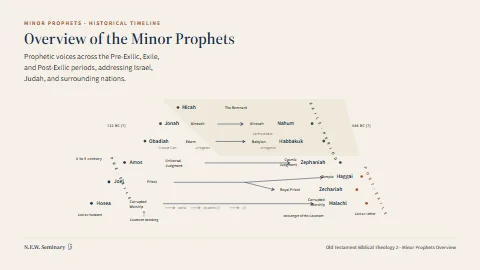
Introduction to the Book of Micah and the Minor Prophets
Pastor Hoon Kim introduces the Book of Micah by demonstrating how the twelve Minor Prophets function as one unified redemptive narrative pointing to Christ and His remnant. He examines the dangerous spiritual rot...