Listen
The whole sermon (computer voice)38:14 · 9.2 MB
Parts of the sermon (6)
- The Grace of Suffering and Storms That Empties Usabout 0:02
- God's Mercy in the Storm and Childlike Faithabout 6:37
- The Grace of God Speaking Indirectly Through Gentilesabout 12:30
- The Providence of Casting Lots Turning Chance into Certaintyabout 21:26
- The Grace of the Question That Reveals Our Identityabout 26:39
- Part 6: Especially when I was in Germany, staying...about 34:47
Read the whole sermon 52 KB. Reading uses much less data than listening.
In three minutes (computer voice)2:11 · 523 KB
Pastor Hoon Kim examines Jonah 1:4–17 to reveal five sovereign means of grace God deploys in the storms of life to empty our self-reliance and draw us to genuine repentance. Moving from the tossing of cargo to the provision of the great fish, this message shows that God's relentless pursuit leads ultimately to the saving mercy of the cross.
Downloads
On a phone, the sermon is easiest to read on its own page: Read the whole sermon, above.
- Audio (MP3)To listen without internet, or to send9.2 MB
- Three-minute summary (MP3)A short voice message to send523 KB
- Study guide (PDF)Questions for a small groupBest for printing267 KB
- Notes page (PDF)One page to hand out, with room for notesBest for printing189 KB
- Resources (PDF)Notes to prepare your own sermonBest for printing899 KB
- Visuals (PDF)Pictures to show while you teachBest for printing1.0 MB
- Card to share (picture)For WhatsApp, Messenger, or any app135 KB
- WhatsApp messages (text)One message for each day of the week2 KB
- The sermon (text)To read or print37 KB

Grace and salvationSuffering and trialsRepentance and forgivenessGod's characterThe Word of GodJonah
The original sermon in Korean
Hear the sermon as it was first preached, in Korean.
Read it in Korean · Watch on YouTube
Study guide
Core Truth
In the severe storms of our lives, God relentlessly pursues us not to destroy us, but to empty us of our self-reliance and draw us to repentance through diverse, sovereign means of grace.
Key Verse
“Then the LORD hurled a great wind upon the sea, and such a violent storm arose that the ship was in danger of breaking apart.”
Jonah 1:4 · BSB
Background Notes
- The Literary Design of Jonah: Far from being a simple children's morality tale, the book of Jonah is a masterpiece of Hebrew prophetic satire. Jonah embodies the stubbornness, spiritual blindness, and nationalistic pride of eighth-century BC Israel, while the pagan mariners demonstrate humility, moral sensitivity, and reverence before Yahweh.
- The Key Verb Hitil (To Hurl): The Hebrew verb hitil appears four times in Jonah 1: Yahweh hurls the storm (v. 4), the sailors hurl the cargo (v. 5), Jonah tells them to hurl him overboard (v. 12), and the crew hurls Jonah into the sea (v. 15). The repetition highlights that God is the supreme orchestrator using circumstances to empty human pride.
- The Mirror of the Captain's Command: When the pagan captain tells the sleeping Jonah, "Get up and call out to your god!" (v. 6), he uses the exact two Hebrew verbs (qum, qara) that God originally commanded Jonah in verse 2 ("Arise, go... and call out"). When we ignore God's direct voice, He often speaks His Word back to us through secular, unexpected channels.
- Identity and Religare: The Latin root of religion (religare) means "to bind together" or "to connect." True identity cannot be derived from earthly achievements, job titles, or cultural background, but only through a living, humble relationship with the Creator.
Discussion Questions
- Understanding the Text: Read Jonah 1:4–6. Why do you think Jonah was able to sleep deeply in the lower deck while the experienced pagan sailors were terrified for their lives? What does this reveal about the nature of spiritual denial?
- Examining the Rebukes: In verse 6, God uses an unbelieving ship captain to deliver His message to Jonah. Can you think of a time when God used an unexpected person, perhaps an unbeliever, a coworker, or a family member, to point out a blind spot or speak truth into your life? How did you respond?
- Childlike vs. Childish Faith: Pastor Kim contrasted "childish faith" (throwing tantrums and demanding our own solutions) with "childlike faith" (trusting God's character without demanding instant answers). In your current prayers and struggles, which of these postures best describes your attitude?
- Confession vs. Reality: In verses 8–9, Jonah gives a doctrinally perfect answer: "I worship the Lord, the God of heaven, who made the sea and the dry land." Yet his feet were running in the opposite direction. Where in your life is there a gap between your theological knowledge and your daily obedience?
- Personal Application: Read Jonah 1:17 and 1 Corinthians 10:13. God prepared a great fish to catch Jonah when he was sinking into the deep. Where do you need to stop clinging to your own solutions and trust that God has already prepared His way of grace and rescue for you?
Phone Summary (for WhatsApp / SMS)
When life's storms hit, God is not abandoning you; He is relentlessly pursuing you to empty your pride and draw you back to His grace. Do not throw childish tantrums demanding your own way out, but trust His sovereign mercy. Even in the deepest waters, God prepares His rescue.
"Then the LORD hurled a great wind upon the sea, and such a violent storm arose that the ship was in danger of breaking apart." (Jonah 1:4, BSB)
Teaching outline
- Main Scripture: Jonah 1:4–17
- Big Idea: In the storms of life, God sovereignly pursues us not to destroy us, but to empty our self-reliance and draw us back to Himself through diverse means of grace.
Movement 1: The Storm That Empties Us
- Key Scripture: Jonah 1:4–5
- Insight: The recurring Hebrew verb hitil ("to hurl") shows that God hurled the storm so that the sailors would hurl their cargo and Jonah would be hurled into the sea. God shakes our false securities to empty our hands.
- Illustration: The commercial ship bound for Tarshish was like an international cargo flight loaded with precious merchandise. Everything had to be jettisoned to survive.
- Childlike vs. Childish Faith: Childish faith throws self-centered tantrums demanding immediate solutions, while childlike faith rests securely in God's character (Hebrews 5).
- Supporting Visuals: Visual 1 (Title Card), Visual 2 (Word Study: Hitil), Visual 3 (Childlike vs. Childish Faith).
Movement 2: God Speaking Through Unexpected Voices
- Key Scripture: Jonah 1:6 (cf. Jonah 1:2; Jonah 3:9)
- Insight: When Jonah ignored God's direct command, God echoed His exact words through a pagan captain: "Arise, call out!" (qum, qara). The unbeliever asked for the very mercy Jonah refused to proclaim.
- Illustration: Nathan confronting David with a story about a stolen lamb (2 Samuel 12), bypassing David's defenses to expose his hidden sin.
- Response: We must not harden our hearts when confronted by unexpected messengers, but humble ourselves and repent (Acts 2:37 vs. Acts 7:54–60).
- Supporting Visuals: Visual 4 (God's Voice Through Unexpected Messengers).
Movement 3: Providence Turning Chance into Certainty
- Key Scripture: Jonah 1:7
- Insight: What pagans attributed to luck or fate was actually God's sovereign necessity. God directed the superstitious casting of lots to point directly at Jonah.
- Illustration: Francis Thompson's poem The Hound of Heaven: God relentlessly trails the running soul, closing every door until we surrender.
- Application: A believer who sought out a fortune teller was told, "Go believe in Jesus properly!" Faith recognizes that repeated trials are God's divine appointments, not random accidents.
- Supporting Visuals: Visual 5 (From Chance to Divine Necessity).
Movement 4: The Question That Reveals Our Identity
- Key Scripture: Jonah 1:8–12; Psalm 119:71
- Insight: The sailors' rapid questions ("Who are you?") exposed the chasm between Jonah's orthodox theological confession ("I worship the Lord, the God of heaven, who made the sea") and his rebellious, runaway life.
- Insight on Religion: The word religion comes from Latin religare ("to bind or relate"). We cannot define ourselves by name, job, or nationality, but only in relationship to the personal Creator.
- Application: Affliction shatters our busy, automatic routines and forces us to confront who we are before God.
- Supporting Visuals: Visual 6 (Who Are You?).
Movement 5: The Prepared Fish and the Shadow of the Cross
- Key Scripture: Jonah 1:13–17; 1 Corinthians 10:13; Matthew 12:39
- Insight: Jonah preferred drowning to repentance, but God prepared a great fish to preserve him. God provides a way of escape in every trial.
- Pastor Kim's Story: Stranded in Germany for three months in his late forties with crushing debts and no income, God provided an unexpected gift of accumulated tithes upon his return, clearing the debt in a single day and confirming his pastoral call.
- Climax: The sign of Jonah finds its fulfillment in Jesus Christ, who died and rose after three days to deliver rebellious humanity.
- Supporting Visuals: Visual 7 (The Cross: Ultimate Means of Grace).
Response and Prayer
- Stop running from God's sovereign storm.
- Surrender the pride, self-reliance, and religious masks you have been clinging to.
- Trust that the God who sent the storm has already prepared the cross to rescue and restore you.
Prayer
A prayer for “Five Means of Grace in the Storm”
Jonah 1:4-17
Lord, you are the God of heaven,
the Creator who made the sea and the dry land.
Before the foundation of the world, you chose us and called us.
Nothing falls to us by chance,
for you rule every event by your sovereign providence.
You are our Father, our Shepherd, and our Lord,
and your character is worthy of all our trust.
How relentless is your mercy toward runaways!
You could have wiped us out,
yet you pursue us in love to turn us back to yourself.
You hurl the great storm to shake our false refuges,
yet by your grace the breaking ship does not sink.
With a single word you calm the raging sea,
and the hand that sends the storm provides the fish to save us.
Forgive us, Lord, for fleeing from your presence
and sleeping under the illusion that we are safe.
Like Jonah, we speak right words with religious pride
while walking the opposite way.
When your truth exposes our hidden sin,
we put up a wall in anger and harden our hearts.
In trouble we throw childish tantrums, demanding our own answers
instead of looking to you.
Have mercy on us in Christ, so that we do not perish.
We thank you for every instrument of mercy that turns us back:
for storms that empty our hands,
for voices that wake us from sleep,
for the lot of your providence and the questions that show who we are,
and for the fish you prepare to save us.
Above all, we thank you for the sign of Jonah,
leading us to the grace of the cross of Jesus Christ.
Help us throw overboard the cargo we cling to,
our wealth, our achievements, and our religious ego,
so that we trust you with childlike faith.
Pierce our church with humble repentance whenever you speak,
even through an unbeliever,
so we never miss your appointed time of grace.
Awaken our neighbors in life's storms to fear your name and seek your mercy.
Here we are, Lord.
Emptied of our pride and our own solutions,
we offer ourselves to you as living sacrifices.
Send us to arise, go, and cry out with your word.
Through Jesus Christ our Lord,
to whom with you and the Holy Spirit
be all honor and glory forever.
Amen.
A blessing
May the God of peace, who brought back from the dead our Lord Jesus,
the great Shepherd of the sheep, by the blood of the eternal covenant,
equip you with everything good to do his will,
working in us what pleases him, through Jesus Christ. Amen.¹
¹ Drawn from Hebrews 13:20-21.
Scripture behind this prayer: Jonah 1:4-17; Jonah 1:2; Matthew 18:3; Acts 2:37; Ephesians 1:4; Mark 4:39-41; Matthew 12:39-40; Hebrews 13:20-21.
A prayer written with the help of AI to go with Pastor Hoon Kim's sermon. These are not his own words. Shared on 15 November 2026, before its full review.
Scripture quotations: The Holy Bible, Berean Standard Bible (BSB), in the public domain, from eBible.org.
Related teachings
The Prayer in the Belly of the Fish
Pastor Hoon Kim explores Jonah's prayer from the belly of the great fish, revealing how God sovereignly prepares seasons of distress as a womb for the death of the self. Grounded in covenant relationship, true prayer...
The Hound of Heaven and the Salvation of the Outsiders
Pastor Hoon Kim explores the divine paradox of Jonah 1:4–17, showing how Israel's stubborn disobedience opened an unexpected door of saving mercy for pagan sailors. By examining the sailors' journey from human common...
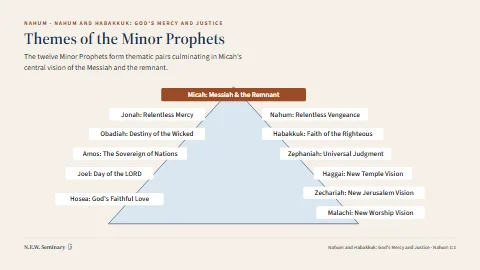
Nahum and Habakkuk: God's Mercy and Justice
Pastor Hoon Kim explores the seventh-century BC prophetic literature, highlighting the theological balance between Jonah's relentless mercy and Nahum's righteous vengeance against Nineveh. He examines God's covenant...