Lecture
Introduction to the Book of Micah and the Minor Prophets
Listen
In three minutes (computer voice)2:11 · 524 KB
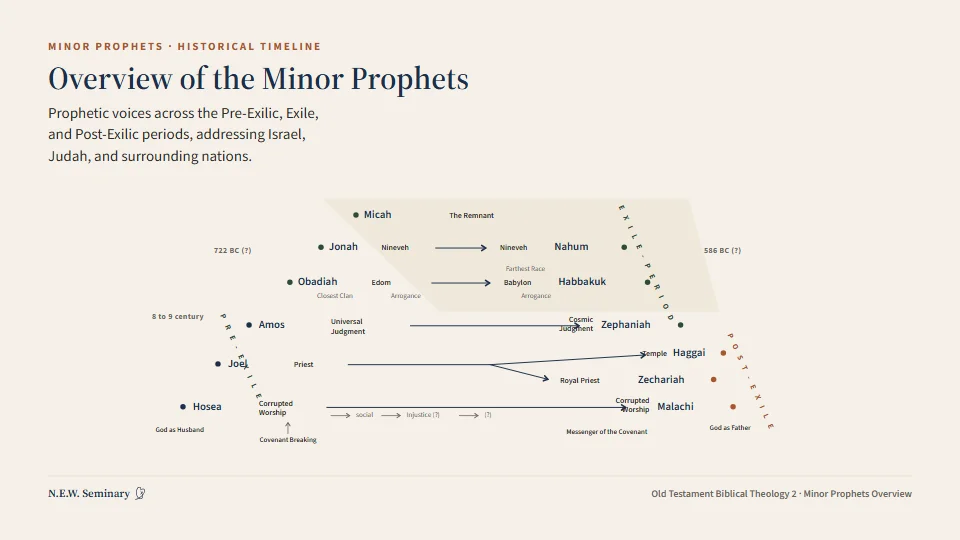
Pastor Hoon Kim introduces the Book of Micah by demonstrating how the twelve Minor Prophets function as one unified redemptive narrative pointing to Christ and His remnant. He examines the dangerous spiritual rot beneath eighth-century BC prosperity, calling ministers to embody prophetic lament and thorough repentance.
Downloads
- Three-minute summary (MP3)A short voice message to send524 KB
- Study guide (PDF)Questions for a small groupBest for printing257 KB
- Notes page (PDF)One page to hand out, with room for notesBest for printing202 KB
- Resources (PDF)Notes to prepare your own sermonBest for printing800 KB
- Visuals (PDF)Pictures to show while you teachBest for printing6.7 MB
- Card to share (picture)For WhatsApp, Messenger, or any app153 KB

The Word of GodGod's characterRepentance and forgivenessWorshipLeadershipHope and eternityMicah
Study guide
Core Truth
God calls His church to read the Minor Prophets not merely as ancient history, but as a mirror exposing false security and corrupt worship, and as a window revealing the Messiah who preserves and thoroughly restores a humble remnant.
Key Verse
"Because of this I will lament and wail; I will walk barefoot and naked. I will howl like a jackal and mourn like an ostrich. For her wound is incurable; it has reached even Judah" (Micah 1:8–9a, BSB)
Background Notes
- The Book of the Twelve: In ancient Hebrew Bibles, the twelve Minor Prophets were written together on a single scroll called The Twelve. Rather than disconnected fragments, they trace a deliberate thematic journey: covenant breakdown, divine discipline, universal judgment, and ultimate restoration through the Messiah.
- The Era of Jeroboam II (c. 789–748 BC): 2 Kings 14:23–29 describes a golden age of northern expansion from Lebo Hamath to the Dead Sea. Because Assyria was preoccupied with internal conflicts, Israel and Judah experienced rapid economic growth. However, this wealth produced systemic oppression, false confidence, and pagan syncretism.
- The Neo-Assyrian Threat: Within a generation after Jeroboam II, Assyria regained military strength under Tiglath-pileser III. Samaria was destroyed in 722 BC, and Sennacherib later marched through the fortified border cities of Judah right up to the gate of Jerusalem (701 BC).
- Prophetic Wordplay in Micah 1: In Micah 1:10–14, Micah uses the literal names of local towns in the Shephelah (Judean foothills) to show how their proudest attributes would become their ruin: Beth Ophrah ("house of dust") rolls in dust; Shaphir ("beauty") is shamed; Lachish ("city of chariots") finds its horses useless.
Discussion Questions
- Understanding the Story: Read 2 Kings 14:23–29 alongside Micah 1:1–5. Why did Israel feel so secure during this period, and what was God's actual assessment of their spiritual health?
- The Prophetic Mirror: Pastor Kim explained that prophetic books act first as a mirror and then as a window. When you look into Micah 1, what subtle forms of self-reliance or formal, empty worship do you see in your own life or church?
- The Heart of a Shepherd: Read Micah 1:8. Instead of gloating over the coming judgment, Micah stripped off his sandals and wailed like a jackal. How does Micah's brokenhearted response challenge the way we respond to moral failure and cultural decay around us?
- Where Do We Place Our Trust? Micah condemned Lachish because it relied on imported Egyptian war chariots rather than the Lord (Micah 1:13). What modern "chariots" (resources, strategies, political influence) are churches and leaders tempted to depend on today?
- Living as the Remnant: Through the window of the prophets, we see Jesus Christ, our true Shepherd. What does it look like practically for a small group or local church to live as God's faithful, humble remnant this week?
Phone Summary (for WhatsApp / SMS)
The Minor Prophets are not dusty history; they are a mirror that exposes our false security and empty worship, and a window revealing Christ's restoring mercy. When Israel had full barns and secure borders under Jeroboam II, their hearts turned to idols and carnal pride. Like Micah, we must mourn over compromised worship and look to Jesus, the true Shepherd who preserves and thoroughly heals His people. "Because of this I will lament and wail; I will walk barefoot and naked. I will howl like a jackal and mourn like an ostrich." (Micah 1:8, BSB)
Teaching outline
Introduction to the Book of Micah and the Minor Prophets
Main Passage: Micah 1:1–9 (with 2 Kings 14:23–29 and Micah 1:10–14)
The Big Idea: The prophetic word exposes our false security and broken worship as a mirror of repentance, while serving as a window of hope pointing to the Messiah who thoroughly restores His humble remnant.
Movement 1: The Twelve Prophets Form One Story of Redemption
- Scripture: Micah 1:1; 5:2; Habakkuk 2:4; Jonah 3–4; Nahum 1–3
- Insight: The twelve Minor Prophets are not twelve random books. They tell one story: moving from Israel's unfaithfulness (Hosea) to cosmic restoration. Right at the center stands Micah, the "little Isaiah," pointing directly to the Messiah born in Bethlehem and the preservation of a faithful remnant.
- Supporting Visuals: Visual 115, Visual 116, Visual 117
Movement 2: Material Prosperity Can Blind Us to Spiritual Danger
- Scripture: 2 Kings 14:23–29; Micah 1:1–5
- Insight: Under Jeroboam II, Israel's borders expanded from Lebo Hamath to the Dead Sea because the Assyrian Empire was temporarily weak. The people enjoyed peace and wealth, but their full barns led to empty worship and high-place idolatry. When Assyria revived, their false security collapsed.
- Supporting Visuals: Visual 128, Visual 130, Visual 131, Visual 135
Movement 3: Three Voices, One Message for the Heart
- Scripture: Hosea 1:1–2; Amos 5:24; Micah 3:1–4; 6:8
- Insight: The three eighth-century prophets address three deep failures: Hosea asks, "Who is your true Husband?" and calls unfaithful hearts to return (shuv); Amos asks, "Who is your true Master (Ambuye)?" and demands justice (tzedaqah); Micah exposes corrupt leaders and points to God as the true Shepherd and coming King.
- Supporting Visuals: Visual 138, Visual 119
Movement 4: The Prophet Weeps Before He Preaches
- Scripture: Micah 1:8–9
- Insight: When Micah saw the approaching judgment, he did not celebrate. He stripped off his outer clothes, walked barefoot like a captive slave, and howled like a jackal in the night. True pastoral and prophetic ministry begins with tears and intercession over the broken state of the church.
- Supporting Visuals: Visual 1 (Wordplay and Lament)
Movement 5: False Security Falls, but Restoration is Thorough
- Scripture: Micah 1:10–14
- Insight: Micah played on the names of Judean towns: Shaphir ("beauty") was stripped naked, and Lachish ("chariot city") found that its imported horses could not save it from God's holy fire. Yet just as God's discipline touched every town, His restoring grace in Jesus Christ reaches every village, community, and nation.
- Supporting Visuals: Visual 137, Visual 2 (Study Handout)
Closing Response
Examine your heart before God:
- The Mirror: What are you leaning on instead of God? Is it money, buildings, reputation, or human connections?
- The Window: Look through your weakness to Jesus Christ. Repent thoroughly, and walk humbly with your God as part of His restored remnant.
Prayer
A prayer for “Introduction to the Book of Micah and the Minor Prophets”
Micah 1:1-9
Lord of Hosts, heavenly King,
you step down from your heavenly palace
to tread upon the high places of the earth.
You alone are the Master of the nations
and the sovereign Judge of all the earth.
You bring down the arrogant, near and far,
and rule over every political power.
Yet you are also the true Husband of your people,
full of faithful covenant love,
and the true Shepherd who leads your flock.
You are relentless in vengeance against rebellion,
and relentless in mercy toward all who return to you.
When your people suffered bitterly with no one to help,
you saw their affliction and did not blot out their name,
speaking your word through your servants the prophets.
We look into the mirror of your prophetic Word
and confess our wickedness and corruption.
In seasons of prosperity we have fallen away,
failing to honor you in our worship
and breaking covenant through spiritual adultery and injustice.
Like the towns of Judah, we have trusted in our own chariots,
boasting in our power, resources, beauty, and money
instead of depending on you alone.
Forgive our arrogance and our failures as leaders,
and cover our shame through Jesus Christ.
We thank you that just as your judgment is thorough,
your salvation and restoration are thorough.
We praise you for the promised Messiah born in Bethlehem,
who bore the Day of the Lord for us in his crucifixion.
Through Jesus Christ, you restore David's tent
and make your church the new remnant,
so that the righteous may live by faith.
Open our hearts to your broken heart,
that we may mourn over failed worship in our churches and nations.
Rake out every sin and false trust from within us,
and lead us through thorough repentance to thorough restoration.
Rule over the struggles among the nations,
raise up faithful leaders and true prophets,
and bring your restoration to every city and remote town.
Here we are, Lord.
Looking through the window of your Word,
we see the remnant people you designed us to be in Christ.
We return to you with humble hearts,
to know you truly, to know justice, and to walk humbly with you.
Through Jesus Christ our Lord,
the promised Shepherd and King of the new creation,
to whom be all glory forever.
Amen.
A blessing
May the Lord, who saves his remnant by grace,
give you the true knowledge of God,
teach you to know and practice his justice,
and lead you to walk humbly with him, now and forevermore.
Amen.¹
¹ Drawn from Micah 6:8.
Scripture behind this prayer: Micah 1:1-9; Micah 1:10-15; Micah 5:2; Micah 6:8; 2 Kings 14:23-28; Habakkuk 2:4; Amos 9:11; Hosea 1:1.
A prayer written with the help of AI to go with Pastor Hoon Kim's lecture. These are not his own words. Shared on 11 November 2026, before its full review.
Scripture quotations: The Holy Bible, Berean Standard Bible (BSB), in the public domain, from eBible.org.
Related teachings
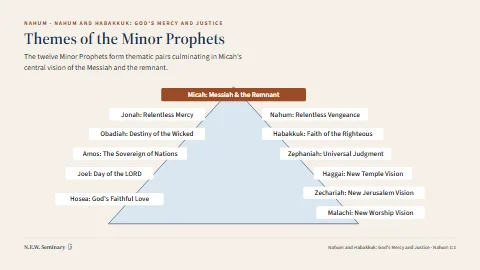
Nahum and Habakkuk: God's Mercy and Justice
Pastor Hoon Kim explores the seventh-century BC prophetic literature, highlighting the theological balance between Jonah's relentless mercy and Nahum's righteous vengeance against Nineveh. He examines God's covenant...
Five Means of Grace in the Storm
Pastor Hoon Kim examines Jonah 1:4–17 to reveal five sovereign means of grace God deploys in the storms of life to empty our self-reliance and draw us to genuine repentance. Moving from the tossing of cargo to the...
The Prayer in the Belly of the Fish
Pastor Hoon Kim explores Jonah's prayer from the belly of the great fish, revealing how God sovereignly prepares seasons of distress as a womb for the death of the self. Grounded in covenant relationship, true prayer...